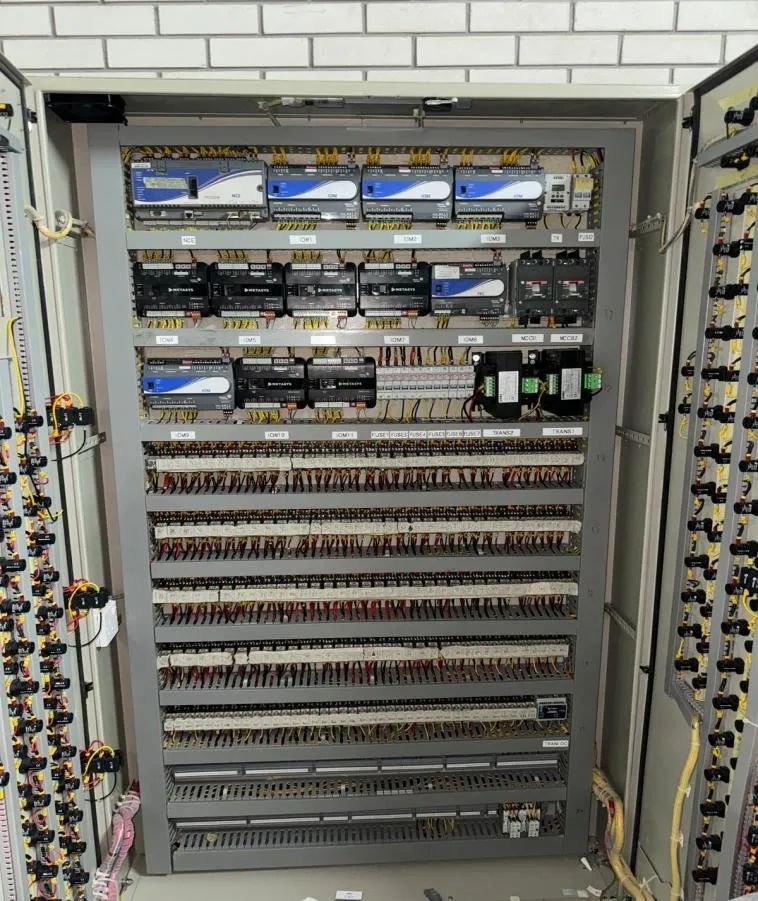

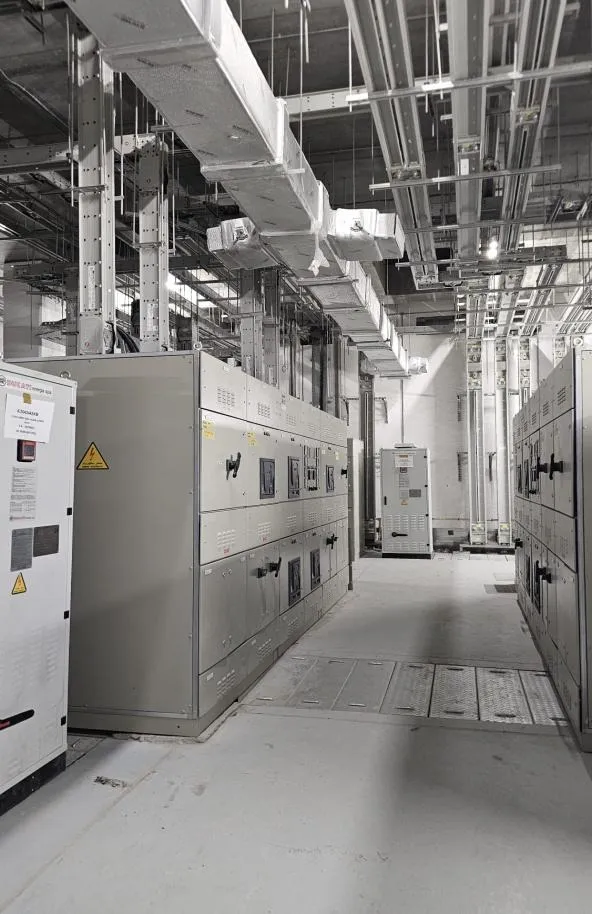
Behind every switch, socket, lift and air conditioner is a quiet piece of engineering that rarely appears in glossy brochures: the power distribution system. It takes electricity from the incoming supply and divides it, again and again, until it reaches thousands of small loads. If it is designed well, nobody notices. If it is designed or installed badly, the whole building feels it, through tripping breakers, overheated panels, dark corridors or, worst of all, danger.
This guide is for owners, consultants and contractors in Kuwait who want to understand low voltage distribution and ask the right questions. Our power distribution systems page shows the scope we deliver.
The path of power through a building
Electricity follows a hierarchy.
- Incoming supply. Power arrives from the utility or a dedicated transformer.
- Main LV panel. The main low voltage switchboard receives the supply, with protection, metering and often a connection for standby generators.
- Sub-main panels. Power is distributed to floors, plant rooms, tenant areas or separate buildings.
- Final distribution boards. These feed lighting, sockets and equipment through individual circuit breakers.
- Loads. Lighting, air conditioning, lifts, pumps, kitchens and the ELV systems described in our ELV guide.
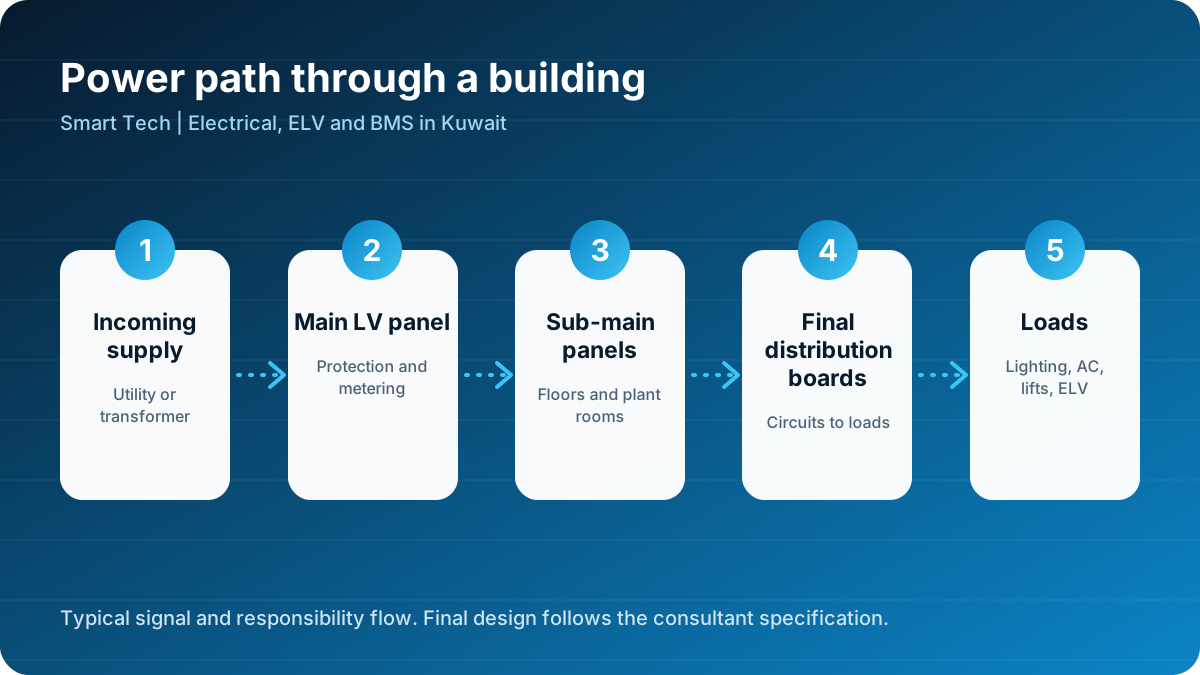
Each stage reduces the scale of the supply and increases the number of circuits. Protection devices at each level are chosen so that a fault is cleared as close to the fault as possible, and the rest of the building stays powered. This principle is called discrimination or selectivity.
What is inside a low voltage panel
A switchboard is more than a metal box. Its key parts include:
- Busbars, thick copper or aluminium conductors that carry current inside the panel.
- Incoming and outgoing circuit breakers, which protect cables and equipment from overload and short circuit.
- Moulded case and air circuit breakers, depending on the current rating.
- Residual current devices, which detect leakage current and protect people from shock.
- Contactors and starters, used for motors and switching.
- Meters and monitoring devices, which measure energy, current, voltage and power factor.
- Surge protection devices, which reduce damage from voltage spikes.
- Control wiring and terminals, which connect indicators, alarms and building controls.
The general design of such assemblies is described by the IEC 61439 series from the International Electrotechnical Commission, and the general concept of switchgear is explained on Wikipedia. Always follow the project specification and local authority requirements.
Designing for Kuwait conditions
Heat
High ambient temperatures reduce the current-carrying capacity of equipment. A panel in a poorly ventilated room in July may run much hotter than the same panel in a mild climate. Designers should check the temperature rating of breakers and busbars and allow for derating. Electrical rooms need ventilation or dedicated cooling, and they should never be used as storage.
Dust and humidity
Dust settles on insulators and enters ventilation openings. Coastal areas bring humidity and salt. Choose an enclosure with a suitable ingress protection rating, use filters where necessary and clean regularly. Outdoor panels need weatherproofing and sun shields.
Voltage and supply quality
Check supply quality and think about power factor correction, harmonics from drives and LED lighting, and surge protection. These matter more as buildings fill with electronic loads.
Generator and standby power
Many buildings have standby generators and automatic transfer switches. Design the changeover carefully, define which loads are essential and ensure fuel, ventilation and testing procedures are in place.
Sizing: the numbers behind the panel
Panel sizing starts with a load schedule, a list of every load with its rating and its diversity. Diversity recognises that not everything runs at once. The main points are:
- Connected load is the sum of all equipment ratings.
- Maximum demand is the realistic peak after applying diversity.
- Spare capacity is deliberately left for growth.
- Fault level is the maximum short-circuit current the system can deliver. Every breaker and busbar must be rated to withstand and break this current.
Never choose a panel by price per way alone. The short-circuit rating, form of separation, quality of busbars and temperature rise matter far more than the number of breakers.
Protection and safety
Earthing and bonding
A good earthing system protects people and equipment. Earth electrodes, bonding conductors and equipotential bonding should be designed and tested. Refer to standards such as the IEC 60364 series on low-voltage electrical installations.
Residual current protection
Residual current devices disconnect quickly when current leaks to earth. They are essential for socket outlets and wet areas.
Arc fault and short circuit protection
Choose breakers and settings that clear faults safely, and ensure the cable ratings match.
Labelling and safety
Every panel should carry a clear single line diagram, circuit schedules, warning labels and a unique identifier. During maintenance, accurate labelling prevents accidents.
Panel types and when to use them
| Panel | Typical role | Notes |
|---|---|---|
| Main LV switchboard | Receives main supply | Highest fault rating and most careful design |
| Motor control centre | Pumps, fans, chillers | Starters, drives and protection |
| Sub-main board | Floors and plants | Often with metering |
| Final distribution board | Lighting and sockets | Neat circuit schedules and spare ways |
| Automatic transfer switch panel | Standby generator changeover | Needs testing programme |
| Metering panel | Tenant or floor sub-metering | Supports billing and energy management |
Cables, containment and installation quality
Panels are only as good as the cables connected to them. Installation quality is where many problems arise.
- Cable selection: size for current, voltage drop, ambient temperature, grouping and the fault duration.
- Containment: use trays, ladders and conduits supported correctly, with segregation from ELV cables.
- Glands and entries: seal them to maintain the enclosure rating and prevent entry of insects, dust and water.
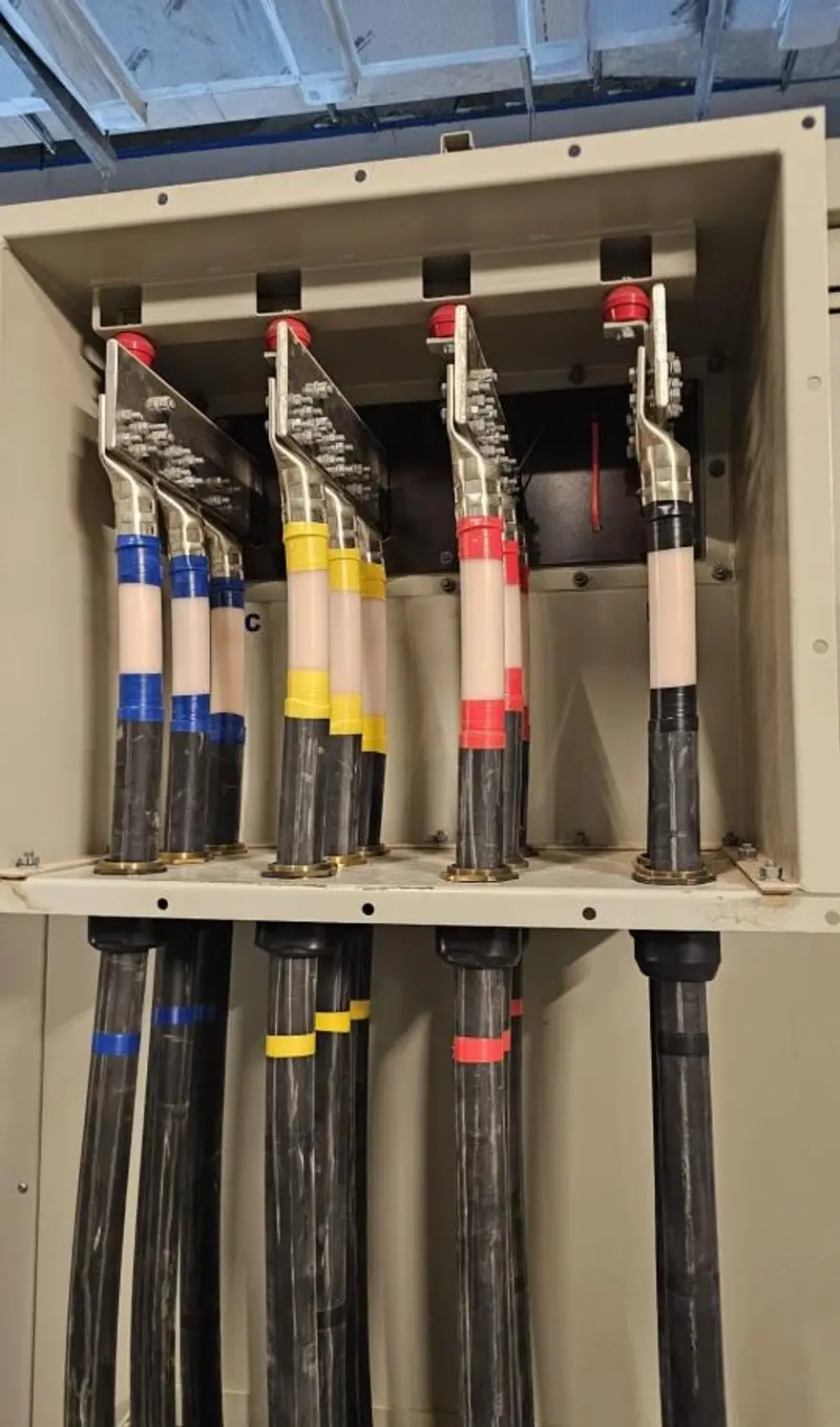
- Terminations: use the correct lugs and crimping tools, and tighten to specified torque. Loose connections cause heat and failures.
- Fire stopping: seal penetrations through fire-rated walls and floors.
- Spare capacity: leave space for future ways and cables.
Neat work looks good, but more importantly it can be checked. A technician who can follow every cable with ease is far more likely to find a fault quickly.
Testing and commissioning
Before energising, a series of checks should be carried out and documented.
- Visual inspection against drawings and specification.
- Insulation resistance tests on cables and busbars.
- Continuity tests of protective conductors.
- Earth resistance tests of the earthing system.
- Torque checks on terminations.
- Functional tests of breakers, interlocks, changeovers and alarms.
- Protection settings applied and recorded.
- Thermal imaging after load is applied, to find hot spots.
Our guide to testing, commissioning and maintenance explains how to document and witness these tests.
Monitoring and integration
Modern panels often include meters with communication. Connecting them to a building management system lets owners see consumption by floor, tenant or system and spot unusual load. Alarms for breaker trips, low power factor and high temperature allow early action. Monitoring also supports lighting control and air conditioning optimisation.
Where power distribution projects occur in Kuwait
- Al Ahmadi and Fahaheel include industrial and institutional sites with heavy motor loads and demanding environments. See Al Ahmadi and Fahaheel.
- Farwaniya has commercial and mixed-use buildings where tenant fit-outs require new distribution boards and sub-metering. See Farwaniya.
- Kuwait City and Hawalli feature towers and malls with complex main and sub-main systems. See Kuwait City and Hawalli and Salmiya.
- Al Jahra and Mubarak Al-Kabeer combine new housing, schools and commercial developments. See Al Jahra and Mubarak Al-Kabeer.
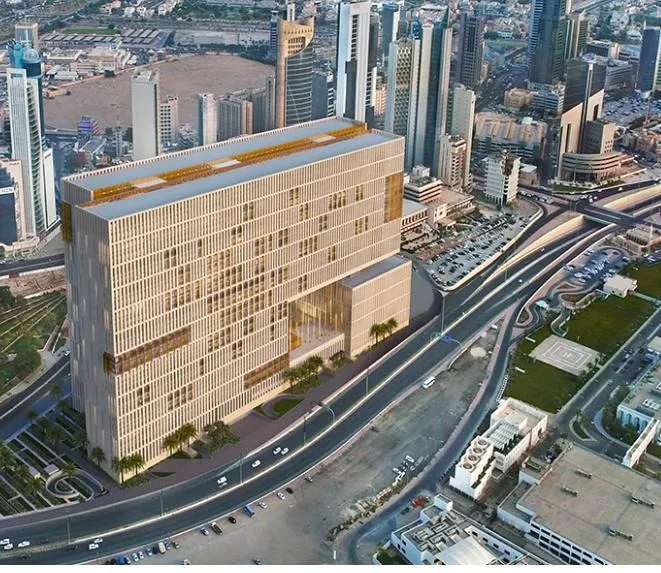
For examples of the type of work we undertake, see our projects, including the Kuwait Stock Exchange and the New Palace of Justice.
How to write a panel specification
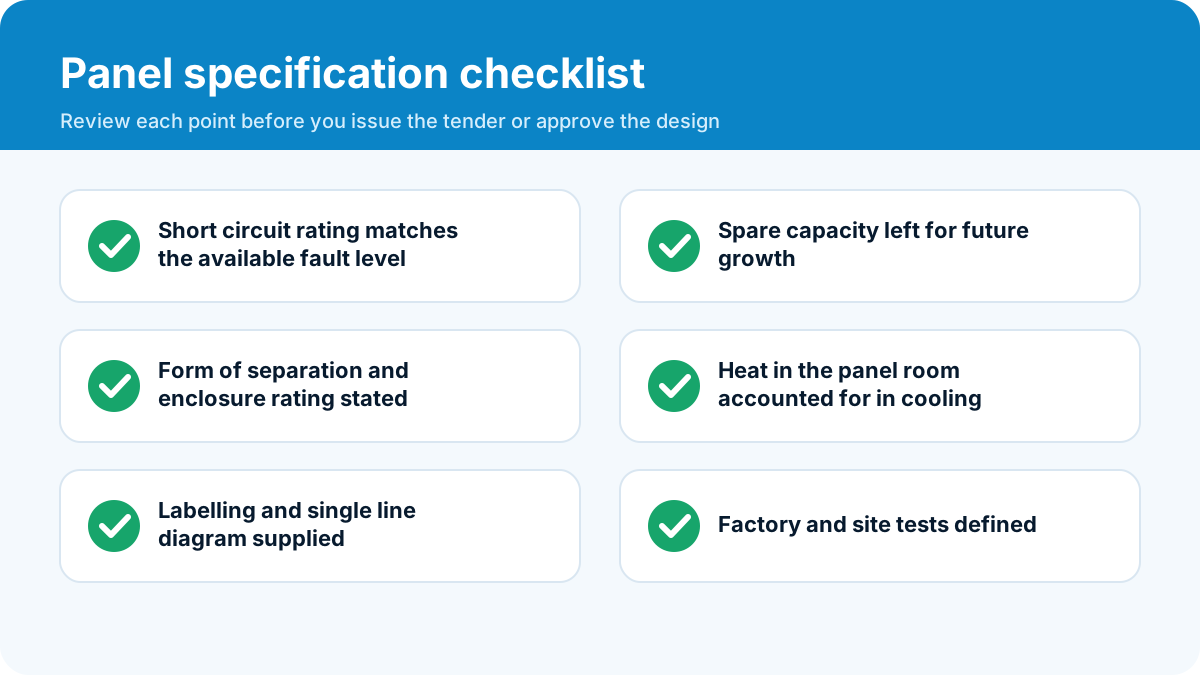
If you are a consultant or owner, a clear specification prevents disputes. Include:
- Standards the assembly must follow.
- Ratings: rated current, short-circuit withstand, rated voltage, ambient temperature.
- Form of separation and enclosure type.
- Breaker types and brands with equivalent options.
- Metering and communication requirements.
- Spare capacity in ways and space.
- Labelling requirements and drawing deliverables.
- Factory and site tests, witness points and documentation.
- Warranty and spare parts.
Maintenance that prevents outages
Panels do not fail without warning. They give signs: warm enclosures, buzzing sounds, discolouration, tripped breakers. A maintenance plan should include:
- Quarterly: visual checks, temperature checks and cleaning of ventilation filters.
- Annually: thermal imaging under load, tightening checks by a qualified person, breaker operation tests and review of protection settings.
- After any fault: inspect, record and fix the root cause before restoring.
Always follow safe isolation procedures, use qualified personnel and respect lockout rules.
A worked example: sub-main distribution for a six-storey commercial building
To see how the principles fit together, take a six-storey commercial building in Farwaniya with retail on the ground floor, offices on floors one to five and a roof plant area.
The utility feeds a transformer room, and from there the main LV panel receives the supply. The main panel feeds four groups: a lift and fire pump group with priority protection, a common-areas group for corridors, car park and façade, an HVAC group for the chiller and air handling units, and a tenant group with one sub-main board per floor.
Each floor sub-main board has a metering section so the landlord can bill tenants fairly, and each tenant has a small final distribution board with its own protection and an emergency lighting circuit. A standby generator supplies essential loads through an automatic transfer switch: fire pumps, lifts, emergency lighting, the security system and selected ELV equipment such as the fire alarm panel and network room.
Notice how each decision reduces the chance that a single fault will take the whole building down. A fault in a tenant's fit-out trips only that tenant's breaker. A fault on one floor does not affect other floors. A mains failure keeps life-safety systems running. This is what good distribution design looks like, and it is the reason experienced engineers spend so much time on single line diagrams.
Energy efficiency and power quality
Distribution design has a direct effect on energy cost and equipment health.
- Right-size transformers and cables. Oversized equipment wastes energy in no-load losses, while undersized cables lose power as heat.
- Correct the power factor. Capacitor banks reduce reactive current, which can lower charges and free capacity, but they must be selected with care where harmonic loads are present.
- Manage harmonics. Drives, LED lighting and computers produce harmonic currents that heat cables and transformers. Filters or suitably rated equipment may be needed.
- Sub-meter major loads. Chillers, lifts, kitchens and tenants should have meters so that waste can be found and billed correctly.
- Balance the phases. An unbalanced three-phase system wastes capacity and overheats neutral conductors.
Power quality problems are often invisible until equipment fails. A short monitoring study with a power quality analyser can reveal problems that would otherwise take years to appear, and it is a sound investment before a large expansion.
Safe working around switchboards
Switchboards carry lethal energy. Only trained, authorised people should open them, and every task should follow a written safe system of work. Isolate, lock out, prove dead and earth where required before touching conductors. Use insulated tools and appropriate protective equipment, and never work alone on live panels. Keep the room clear, keep doors closed and keep a record of every entry. Visitors and cleaners should be briefed before entering electrical rooms. These habits protect lives, and they also protect the equipment and the continuity of the building.
Common mistakes
- Underestimating fault level. The equipment may not survive a short circuit.
- No spare capacity. Small additions force expensive changes.
- Hot electrical rooms. Equipment ages quickly.
- Poor labelling. Maintenance becomes dangerous and slow.
- Loose terminations. A leading cause of overheating.
- No single line diagram. Nobody can verify what is installed.
- Ignoring harmonics. Electronic loads need attention.
Work with an experienced team
Send us your load schedule, single line diagram or a description of the site. We will review the information, raise questions and prepare a clear quotation including testing and documentation. Request a price with our quote form or call +965-51133630. You can also explore our full range of services.
Power distribution is not glamorous, but it is the foundation of every other system. Build it well and everything built on top of it works better.
Frequently asked questions
What is the difference between a main distribution board and a sub-main board?
The main distribution board receives the incoming supply and feeds the rest of the building. Sub-main boards receive power from the main board and feed floors, plant rooms or tenants. Final distribution boards then feed individual circuits.
What standard applies to LV switchboards?
Low voltage switchgear and controlgear assemblies are covered internationally by the IEC 61439 series. The project specification and the authority determine exactly what applies.
How much spare capacity should a panel have?
A common design practice is to leave spare space and spare ways for future circuits, often around 20 to 30 percent, but the figure depends on the project and the specification.
Why do panels overheat in Kuwait?
High ambient temperature, poor ventilation, loose terminations and overloaded circuits all raise temperatures. Panels should be rated for the ambient temperature, rooms should be ventilated or cooled and connections should be inspected.
Do you also supply the cables and containment?
Yes, power distribution scope can include panels, cables, containment, earthing and testing, depending on the project and the contract.