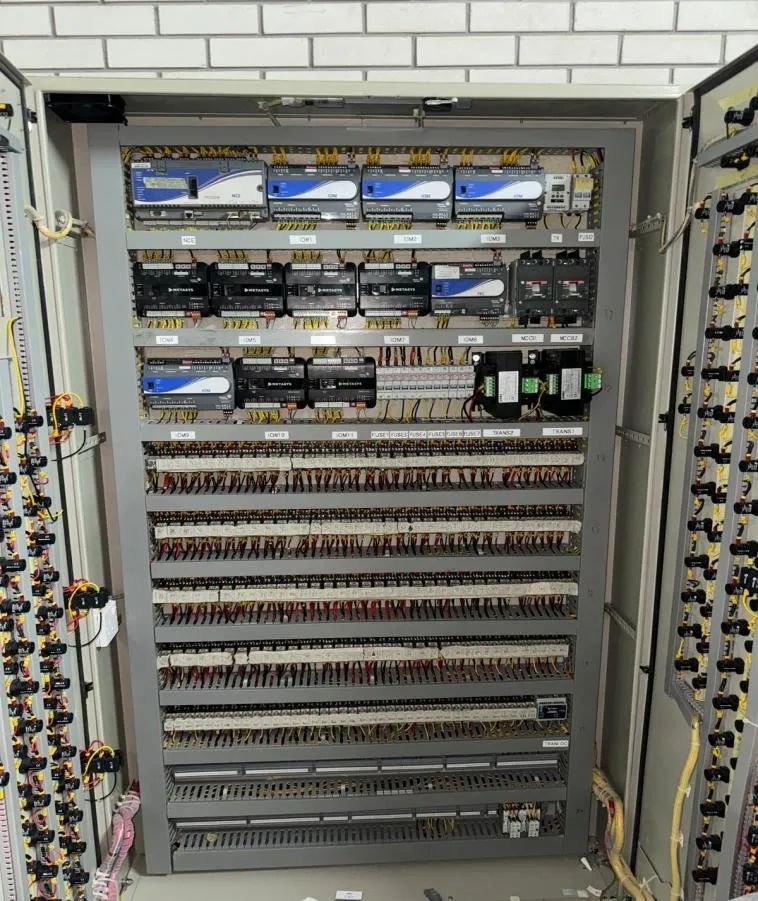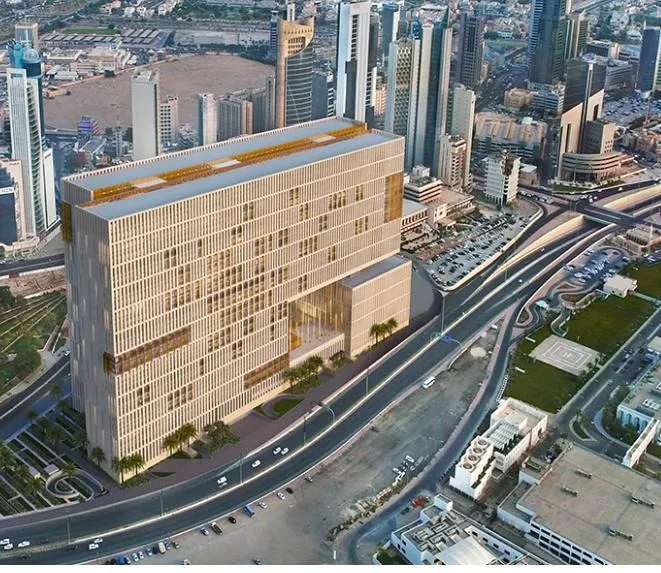

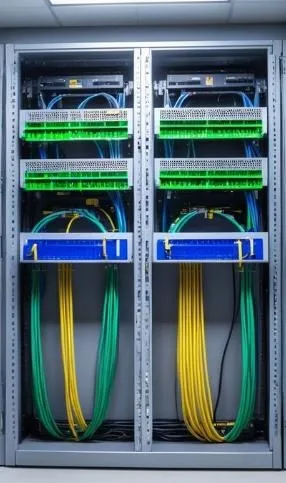
Every modern building in Kuwait runs on two kinds of infrastructure. The first is power: switchboards, cables, lighting and air conditioning. The second is the nervous system that tells people and machines what is happening: cameras, alarms, door readers, telephones, networks and loudspeakers. That second group is what engineers call extra low voltage, or ELV. In everyday site language in Kuwait you will also hear low current, and both words describe the same thing.
This guide is written for building owners, consultants, main contractors and facility managers. It explains what ELV systems are, how they fit together, how to specify them without gaps, and which mistakes cause the most delay on site. It is based on how specialist subcontractors such as Smart Tech plan and deliver this work from our office in Farwaniya.
What counts as an ELV system
A system is ELV when it works at a voltage low enough to reduce electric shock risk and when its job is to carry information or control signals. The international definition is set by electrotechnical standards bodies such as the International Electrotechnical Commission, and the general idea is summarised on the extra-low voltage page of Wikipedia. In a building, the term usually covers these groups:
- Structured cabling and data networks, which carry computers, phones, Wi-Fi access points and cameras. See our telephone and data networks service.
- Telephone and intercom systems, including video door entry for towers and villas.
- CCTV surveillance, covered in detail in our guide to CCTV installation in Kuwait.
- Fire detection and alarm, explained in our article on fire alarm systems in Kuwait.
- Access control and intruder detection, see access control systems in Kuwait.
- Public address, voice evacuation and background music, see public address and voice evacuation.
- Building management systems (BMS), which control and monitor air conditioning, pumps and energy. Read our BMS guide.
- Home automation for villas and apartments, covered in home automation for villas in Kuwait.
Our service page on low current (ELV) systems summarises how these fit into one scope of work.
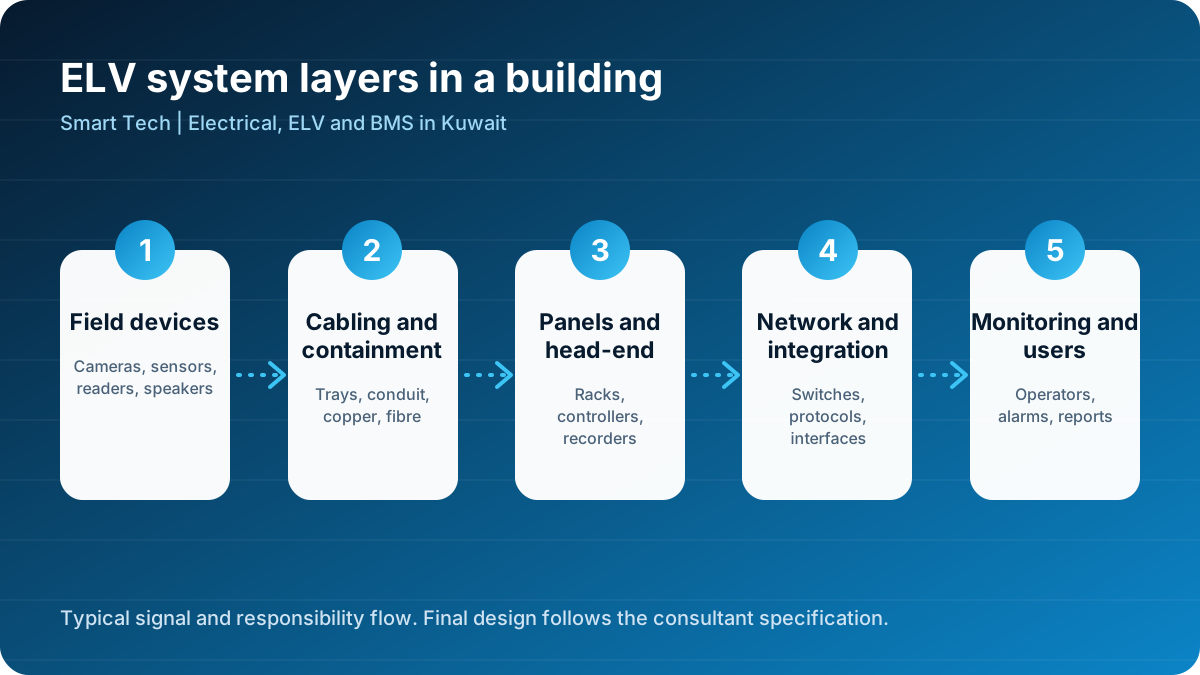
The five layers every ELV system shares
Whatever the system, the design has the same five layers. If you understand them you can read any ELV drawing.
1. Field devices. These are the things people touch or see: cameras, smoke detectors, card readers, speakers, telephones and sensors. They are the most visible part of the job and usually the cheapest part per unit.
2. Cabling and containment. Cables run in trays, conduits and risers. This is where most hidden cost sits, because routes cannot be changed after ceilings, walls and floors are finished. Fire-rated cable is required for many life-safety circuits, and separation from power cables is required to prevent interference.
3. Panels and head-end equipment. Recorders, servers, controllers, amplifiers and fire alarm panels live in rooms or racks. These rooms need power, cooling, access control and space for growth.
4. Network and integration. Modern systems share a network. A camera, a door controller and a BMS panel may all connect to the same switches. Good design separates critical traffic from general traffic and agrees which protocols the systems will use to talk to each other.
5. Monitoring and users. A system that nobody can operate has failed, even if it works. Screens, graphics, alarm lists, reports and training belong in this layer.
Why Kuwait projects have their own challenges
Kuwait is not a hard market to work in, but it has conditions that experienced contractors plan for from day one.
Heat, dust and equipment rooms
Summer temperatures in Kuwait regularly exceed 45 degrees Celsius, with recorded peaks above 50. Electronics inside a poorly cooled rack room age quickly. A rack room needs dedicated cooling that runs all year, not a share of the general office air conditioning that switches off at night. Outdoor cameras and field panels need enclosures with suitable ingress protection and, in exposed locations, sun shields. Dust storms also mean that filters and enclosure seals deserve attention during maintenance.
Many parties, one ceiling
A typical Kuwait project has an architect, a consultant, a main contractor, an MEP contractor and several specialist subcontractors, all working in the same ceiling void. ELV works best when the subcontractor reviews the coordination drawings early and flags clashes before installation. We cover how to choose a partner in our checklist on choosing an electrical and ELV subcontractor in Kuwait.
Approvals and documentation
Fire alarm and other life-safety systems are reviewed and inspected by the competent authority, and the consultant reviews all materials against the specification. Prepare material submittals, shop drawings and test procedures early. Delays at approval stage are among the most common reasons a handover date slips.
How to read an ELV scope without missing anything
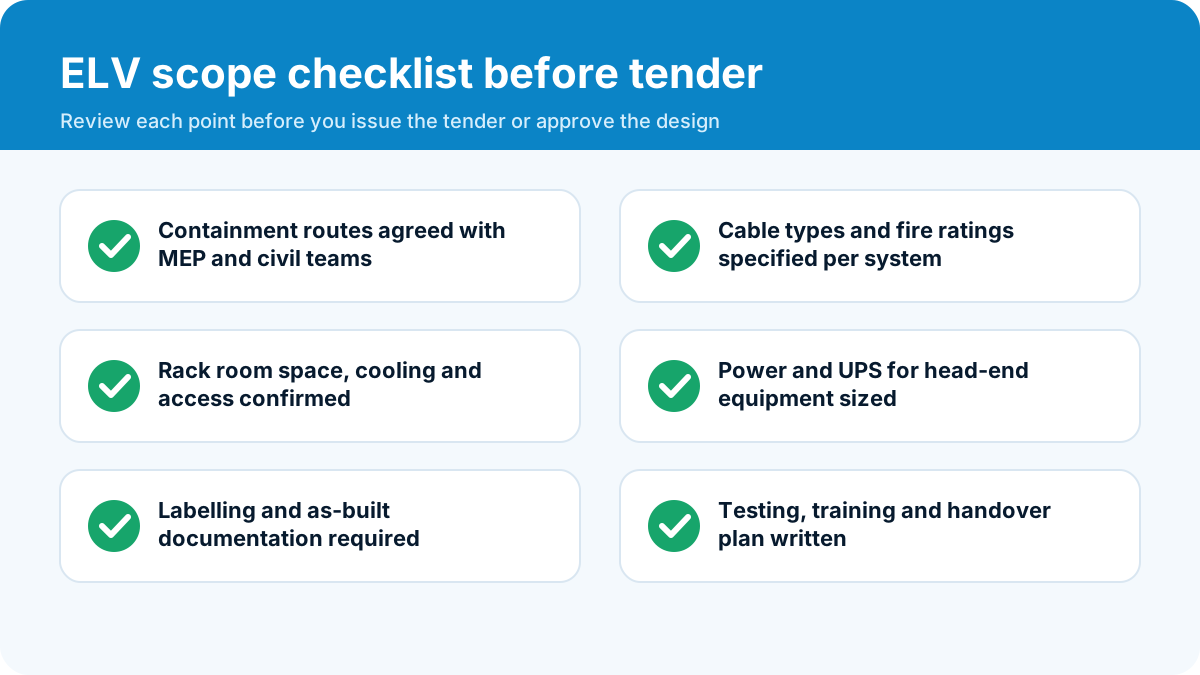
Most disputes on site start with a gap in the scope. Use the following approach when you receive a tender package.
- List every system in the specification and drawings, then match each one to a drawing sheet. If a system appears in the specification but has no drawing, ask a question in writing.
- Separate supply from installation and testing. Check who supplies containment, who installs cable, who terminates and who tests.
- Mark interfaces. Fire alarm to lifts, access control to fire release, CCTV to the network, BMS to the chillers. Every interface needs an owner on each side.
- Confirm power. Does each rack, panel and amplifier have a clean power outlet or UPS feed in the drawings, and who provides it?
- Check the handover list. Test certificates, as-built drawings, manuals, training and warranties should all appear as deliverables with dates.
Typical ELV packages by building type
Different buildings need different mixes of systems. These examples show the thinking, not a fixed rule. Always follow the consultant's specification.
| Building type | Core ELV systems | Common additions |
|---|---|---|
| Villa or private residence | Data, TV, intercom, CCTV | Home automation, multi-room audio |
| Office building | Structured cabling, CCTV, access control, fire alarm | BMS, PA, meeting-room AV |
| School or campus | Data, fire alarm, PA, CCTV | Clock system, access control |
| Mall or retail centre | CCTV, fire alarm, PA, access control | BMS, car park guidance |
| Hotel or resort | Data, CCTV, access control, fire alarm | Guest room controls, nurse-call style paging in spas |
| Industrial site | Fire alarm, CCTV, PA, data | Perimeter detection, gate control |
You can see the kinds of sectors we work with on our industries page, and examples of delivered work on our projects page.
Planning ELV in the areas of Kuwait
Every governorate has its own pattern of buildings, and that affects what ELV design looks like.
Farwaniya. This is where Smart Tech is based. The area has dense residential blocks, commercial streets and mixed-use buildings close to the airport. Projects here are often fit-outs of shops, clinics and offices where data, CCTV and access control must fit into an existing building. See our page on electrical and ELV services in Farwaniya.
Kuwait City. High-rise offices, banks and government buildings make up much of the skyline. These projects demand integrated systems, strict documentation and careful phasing. Read about our work in Kuwait City.
Hawalli and Salmiya. Towers, retail streets and restaurants mean heavy demand for CCTV, fire alarm upgrades and data networks. See Hawalli and Salmiya.
Al Ahmadi and Fahaheel. Housing, schools and industrial sites sit side by side. Industrial customers need rugged equipment and clear maintenance plans. See Al Ahmadi and Fahaheel.
Al Jahra and Mubarak Al-Kabeer. Growing housing, education and commercial development create demand for villas with automation and for schools with PA and fire systems. See Al Jahra and Mubarak Al-Kabeer.
Design principles that prevent problems
Design for growth
A rack that is full on day one is a rack that will be replaced in two years. Leave at least 30 percent spare capacity in rack space, switch ports and containment. Containment is the hardest thing to extend later, so it should have room for extra cable.
Keep life-safety systems separate and simple
Fire alarm and voice evacuation are critical. They should have their own cables, their own power backup and clear documented interfaces. They should never depend on a shared office network for their basic operation. Standards bodies such as NFPA and the British Standards Institution publish the widely used rules for these systems.
Use open standards where possible
When systems communicate using open protocols, the owner is not locked in to a single supplier. For building management, BACnet is a common open protocol, described on Wikipedia's BACnet page. For cabling, international standards such as ISO/IEC 11801, published through the International Organization for Standardization, define performance classes.
Plan cyber security from the start
Cameras, door controllers and BMS panels are computers on a network. Change default passwords, separate the networks, keep firmware updated and limit remote access. Treat these devices with the same care you would give a file server.
Label everything
Every cable, port, panel and device should have a unique, durable label that matches the drawings. When something fails at two in the morning, a clear label saves hours.
Installation: what good site practice looks like
Good ELV installation is mostly about discipline.
- Containment is checked before cable is pulled. Routes, supports, bends and fire stopping are inspected and signed off.
- Cable is pulled once, tested once, labelled once. Pulling cable through poorly prepared routes damages it and causes faults that appear months later.
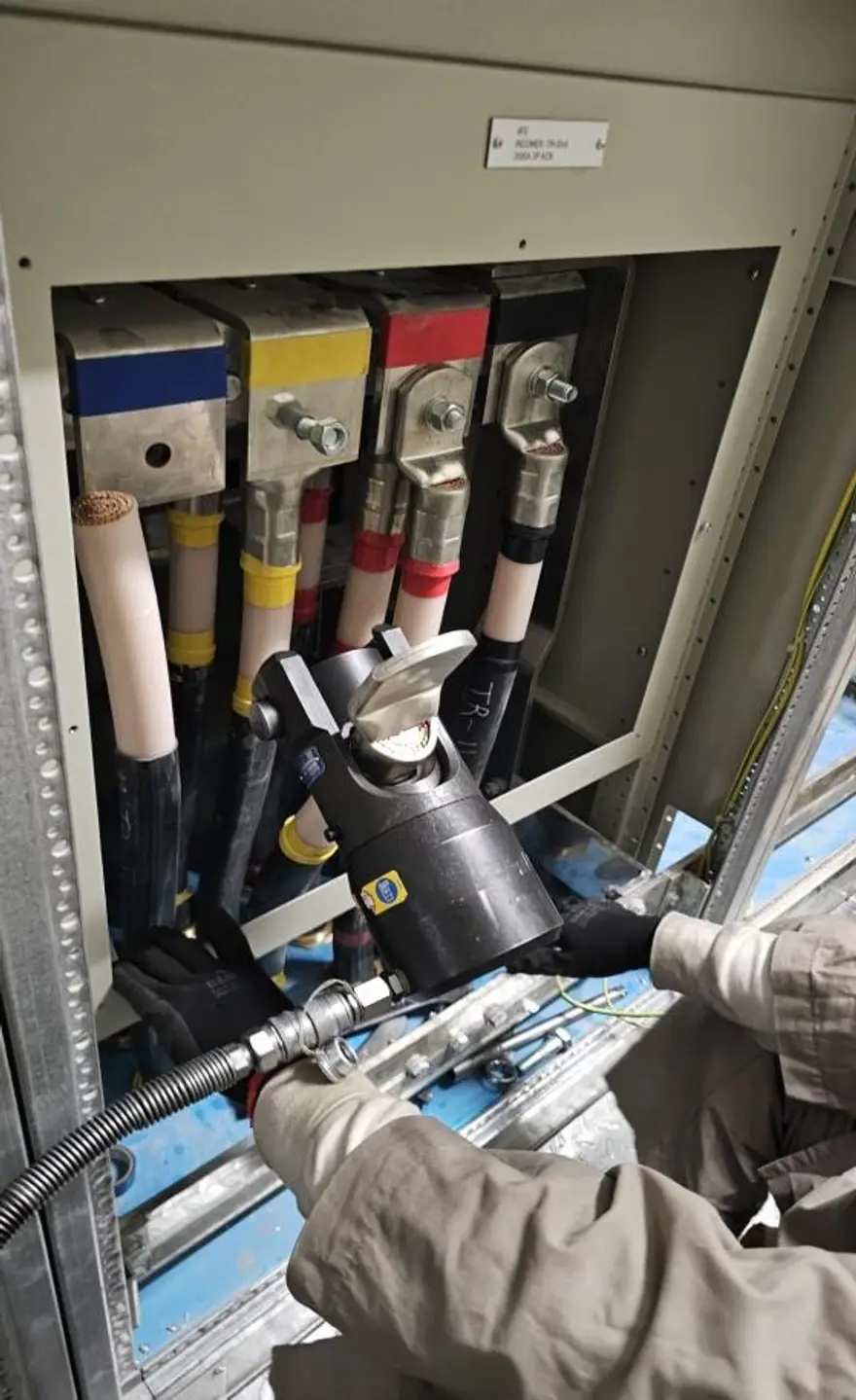
- Terminations are made by trained technicians using the right tools. Poor crimps and loose lugs are a common cause of intermittent faults. Our photographs of cable lugs and crimping work show the level of detail involved.
- Panels are tidy. Cable dressing, spare capacity and clear labelling make future maintenance faster and safer.
- Progress is documented with photographs, test records and marked-up drawings, so that the as-built drawings match reality.
Testing, commissioning and handover
Testing should follow a written plan agreed with the consultant. A typical sequence is visual inspection, cable testing, device-level tests, system-level tests and then an integrated test where systems that interact are tested together. We explain this in our article on testing, commissioning and maintenance.
At handover, the owner should receive as-built drawings, test certificates, equipment data sheets, manuals, passwords, warranties and a spare parts list. Operators should be trained on the real system, not a slide deck.
Maintenance: the part owners forget
ELV systems drift. Cameras are knocked out of focus, detectors get dirty, batteries age, firmware becomes outdated. A simple planned maintenance schedule keeps the system dependable.
- Monthly: check recorder health, alarm panel status, and any fault logs.
- Quarterly: test a sample of detectors, readers and speakers. Check UPS and battery condition.
- Annually: full functional test of life-safety systems, cleaning of devices, firmware review and a review of user accounts.
Keep a log. When an authority or insurer asks for evidence, a good log is the best answer.
Budgeting for ELV
ELV usually represents a modest share of total construction cost, but it is the part that determines whether the building is comfortable, secure and efficient to operate. When comparing quotations, look beyond the total.
- Is containment included or by others?
- Are the brands and models named, and are they equal to the specification?
- Is testing and commissioning included, with documents?
- What warranty is offered, and who responds on site?
- What is excluded?
A low price that excludes testing, documentation or interfaces is not low. It is incomplete.
Common mistakes and how to avoid them
- Starting too late. Involve the ELV contractor at design stage.
- Ignoring rack room design. Size, cooling, power and access are decided early.
- No owner for interfaces. Name the person responsible on each side of every interface.
- Mixing life-safety and general networks. Keep them separate.
- Skipping the as-built drawings. They are the map for every future repair.
- No training. Operators who do not understand the system will not use it well.
- No maintenance plan. Even the best system degrades without care.
Questions to ask your ELV contractor
Before you award a contract, ask these:
- Which similar projects have you completed, and can we see them?
- Who will supervise on site, and what are their qualifications?
- How do you test each system, and what documents do we receive?
- What is your response time after handover?
- How do you manage changes and variations?
You can review sample references on our projects page and our quality and HSE approach.
Getting help with your project
If you are planning a new building, an extension or an upgrade, send us your drawings and scope of work. Our engineers will review them, raise questions early and prepare a clear quotation. Use our quote form or call +965-51133630. For a wider view of everything we install, browse all our services.
ELV is the layer that makes buildings smart, safe and manageable. Plan it early, specify it clearly, test it properly and maintain it, and it will serve the building for many years.
Frequently asked questions
What does ELV stand for and is it the same as low current?
ELV means extra low voltage. In Kuwait the term low current is used for the same family of systems: data, telephone, CCTV, fire alarm, access control, public address and similar systems that run at low voltage and carry signals instead of heavy power.
Which ELV systems does a typical office building need?
Most offices need structured cabling, telephone and data networks, CCTV, access control, fire alarm, and a public address or background music system. Larger buildings add a building management system and integrated security.
Do ELV works need approval from the authorities in Kuwait?
Fire alarm and life-safety systems need approval from the relevant fire authority before installation and again at inspection. Other systems follow the consultant specification and the client's requirements. Always confirm the current requirements for your project.
How early should the ELV contractor be involved?
As early as the design stage. Containment routes, rack rooms, power and cooling are decided early and are expensive to change after the structure and finishes are complete.
Can you work on a building that is already operating?
Yes. Extensions, upgrades and replacements are common. The work is planned in phases so that the building keeps running, and the existing system is documented before anything is changed.