
Walk into the plant room of a large building in Kuwait in July and you will hear it: chillers, pumps and fans working flat out against 45 degree heat. Air conditioning is the single biggest user of electricity in most buildings here, and it is also the system most likely to waste energy because it runs on autopilot. A building management system, or BMS, is the tool that takes the autopilot and gives it eyes, a memory and a set of rules.
This guide explains what a BMS is, what it controls, how it is built, how to specify it so you get what you pay for, and what to expect during installation and handover. It is written for owners, consultants and facility teams in Kuwait.
What a BMS actually does
A BMS monitors and controls the mechanical and electrical equipment of a building from one place. At minimum it will:
- Start, stop and schedule air handling units, fans, pumps and chillers.
- Control temperature, humidity, pressure and flow through valves, dampers and variable speed drives.
- Monitor status and alarms such as a pump failure, high temperature or a dirty filter.
- Record trends and energy use so you can see what happened last night or last summer.
- Present everything on graphics that an operator can understand without reading a manual.
For a technical overview, the building automation page on Wikipedia is a useful reference. Our own building management systems service describes how we deliver this scope.
The anatomy of a BMS
Sensors, actuators and meters
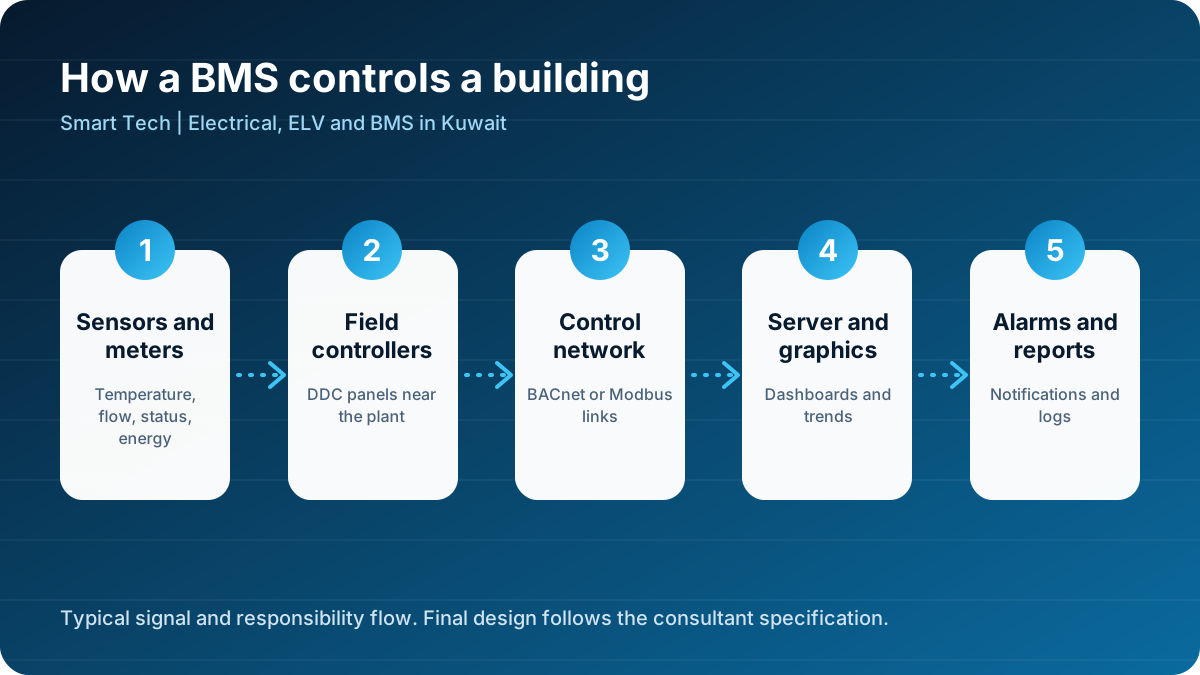
Everything begins with measurement. Temperature sensors, humidity sensors, pressure sensors, flow meters, current transformers and status contacts give the system information. Actuators such as valve motors and damper motors carry out the commands. Energy meters record electricity, cooling energy and water use.
Field controllers
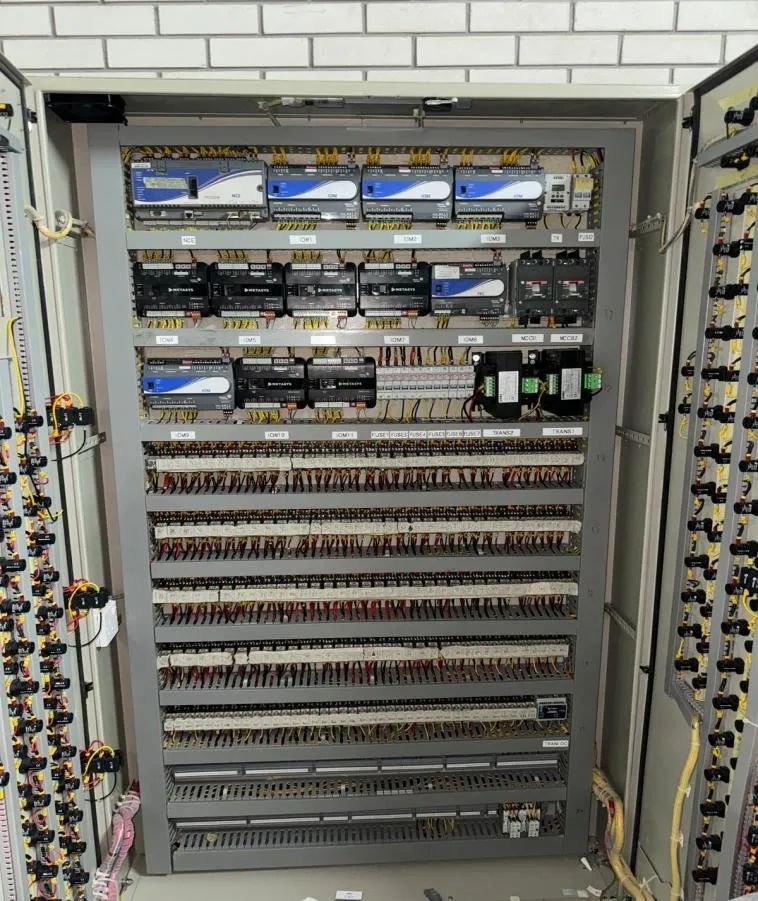
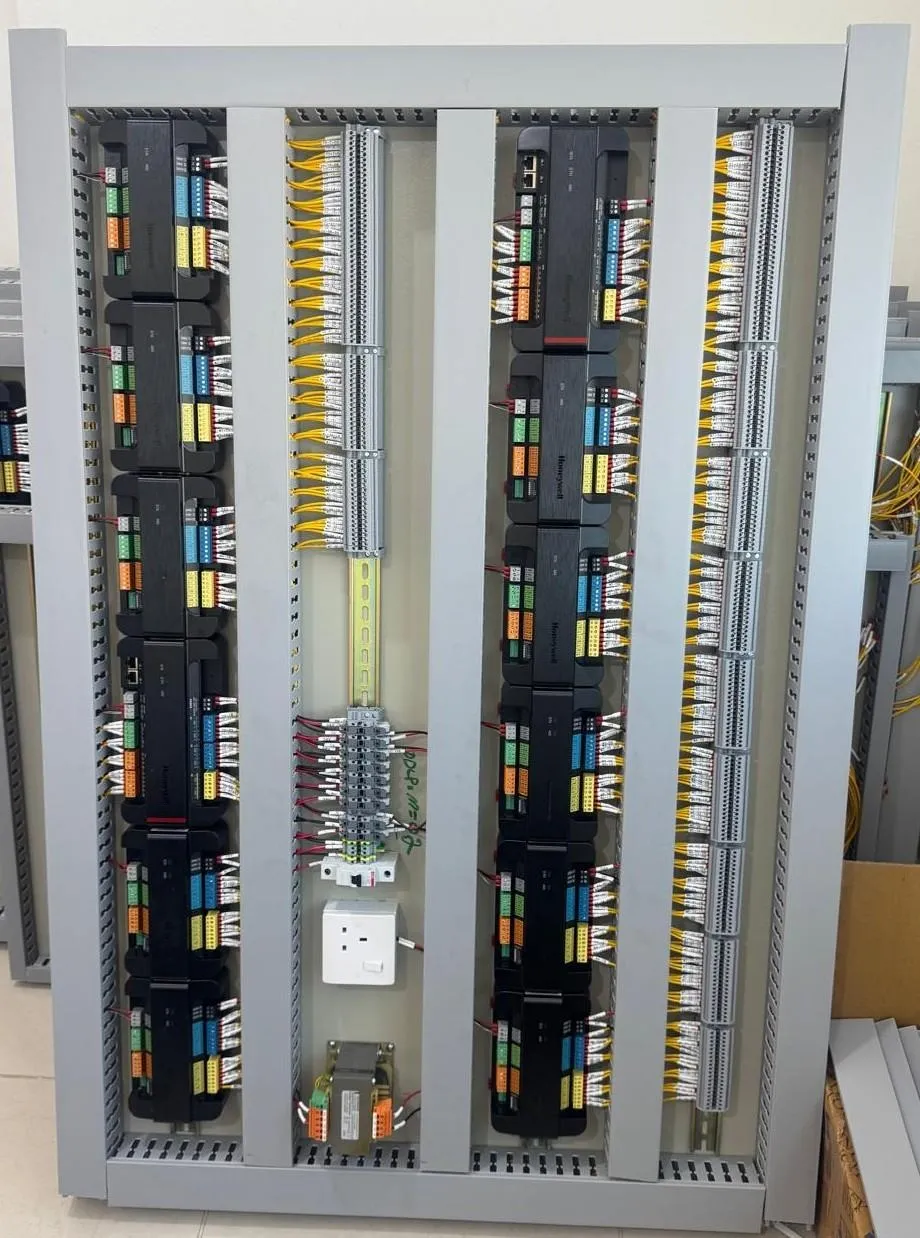
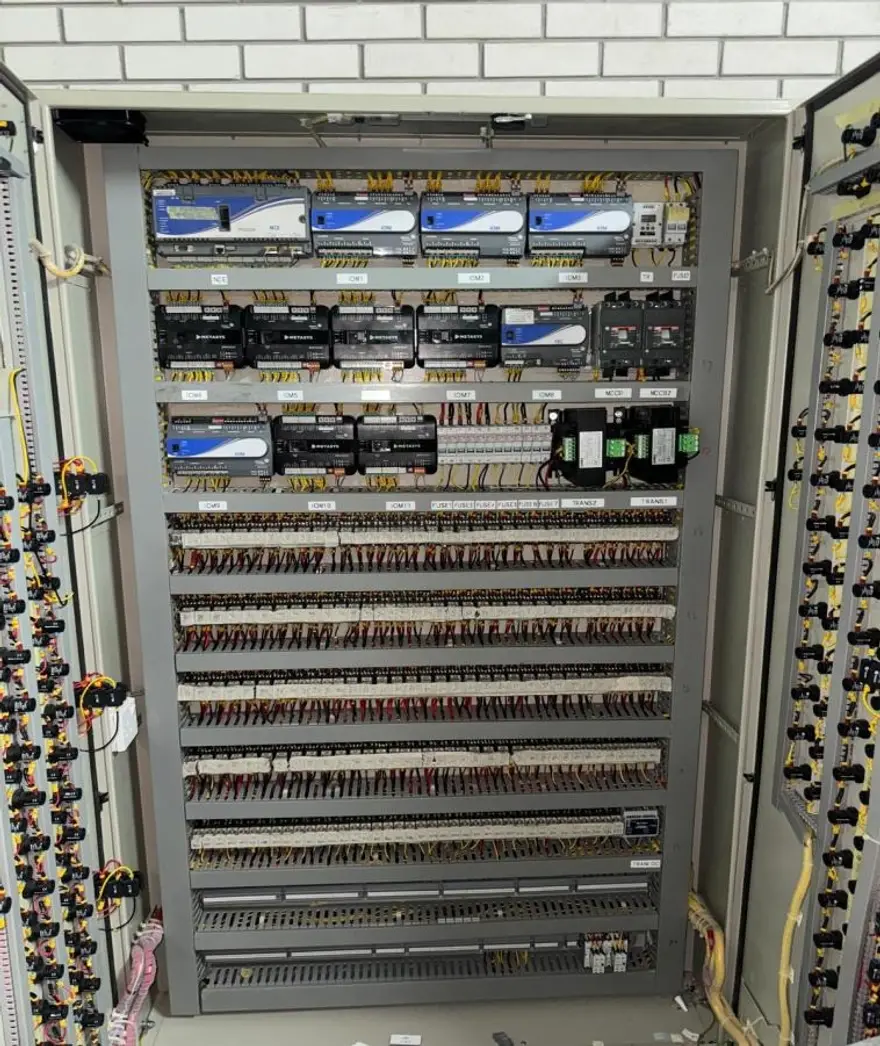
Field controllers, often called DDC controllers (direct digital control), sit close to the plant. Each one runs its own control program. A well designed system keeps working even if the central computer is switched off, because the logic lives in the controllers, not in the server.
The control network
Controllers talk to each other and to the server over a network. In buildings, the common open protocols are BACnet, described on Wikipedia's BACnet page and maintained under the ASHRAE standards family, and Modbus for meters and drives. Using open protocols matters: it means a chiller from one maker, a meter from another and a controller from a third can all be monitored together.
Server, graphics and alarms
The server stores history, serves the graphics and sends alarms by email or messages. Good graphics show the plant as the operator would draw it on paper, with live values, clear alarm colours and one-click access to trends.
What should a BMS control in a Kuwait building
Not every point is worth connecting. Focus on the systems that use the most energy or whose failure is most expensive.
- Chilled water plant. Chillers, pumps, cooling towers or air-cooled condensers, and the loops between them. Optimising the number of chillers running and the water temperatures is where large savings are found.
- Air handling and fan coil units. Schedules, set points, economiser cycles and fault alarms.
- Ventilation and exhaust. Car park carbon monoxide control, toilet and kitchen extract, and smoke control interfaces.
- Pumps and water systems. Booster sets, sump pumps, tank levels and leak alarms.
- Electrical monitoring. Main incomer, generator status, power factor and energy by floor or tenant. See our guidance on power distribution and switchboards.
- Lighting control. Schedules and scenes for common areas, façade and car parks. Read our article on lighting control and energy savings.
- Interfaces to life safety and security. Fire alarm status, access control events and lift status, shown for information, with life-safety functions staying hardwired and independent.
Energy saving in a hot climate
Because cooling dominates electricity use here, the BMS savings story is mostly an air conditioning story. These measures are common and effective.
- Scheduling that matches real occupancy. Equipment that runs at full output in empty offices overnight wastes money. Schedules should follow the real working pattern, including Fridays, Saturdays and holidays.
- Sensible set points. Every degree of overcooling costs energy. Agree set points with the owner and lock them against casual changes.
- Optimised start. Pre-cool the building just enough to be comfortable at opening time rather than running everything for hours before.
- Variable speed control. Fans and pumps on variable speed drives, controlled by the BMS to match demand, use far less energy than fixed speed.
- Fault detection. A stuck damper, a failed sensor or a dirty coil can waste energy for months before anyone notices. Alarms and trend review find them.
- Metering and reporting. You cannot reduce what you do not measure. Sub-metering by floor, tenant or plant item shows where energy is going.
Realistic savings depend on the starting point. A building that was poorly controlled before will save much more than one that was already well run. Be sceptical of any contractor who promises a fixed percentage without studying your building first.
Choosing the right architecture
There is no single right answer, but there are good questions to ask.
| Question | Why it matters |
|---|---|
| Is the logic stored in the field controllers? | The building keeps running if the server fails. |
| Are open protocols used end to end? | You can add or change equipment without being locked to one brand. |
| Who owns the passwords and programs? | The owner should receive programs, graphics and admin rights at handover. |
| Is the system scalable? | New floors or tenants should be easy to add. |
| How is cyber security handled? | The BMS network must be separated, patched and monitored. |
| What is the alarm path? | Alarms must reach a person who can act, at any time. |
From design to handover: the process
1. Brief and survey. Understand the building, the plant and the people who run it. For an existing building, survey the plant condition and what is already controlled.
2. Points list and sequences of operation. The points list is the heart of the design. It lists every sensor, actuator and status connected to the system. The sequence of operation describes in words how each system should behave: what happens when the room is too warm, when a pump fails, when the fire alarm sounds. Insist on a written sequence for every system.
3. Drawings and submittals. Panel layouts, network diagrams, cable schedules and product data sheets are submitted for approval.
4. Installation. Panels, sensors, valves and cables are installed with the mechanical and electrical contractors. Many BMS delays come from late availability of valves or drives, so coordination is key.
5. Testing and commissioning. Each point is tested from the field device to the graphic. Each sequence is demonstrated. Our approach to this stage is described in testing, commissioning and maintenance.
6. Training and handover. Operators learn on the real system. The owner receives programs, graphics, manuals, passwords and as-built drawings.

Typical BMS mistakes in the region
- Too many points, too little purpose. A huge points list that nobody reviews creates noise. Choose points that support decisions.
- No written sequence of operation. Without it, nobody can say whether the system is working as intended.
- Plant not ready when the BMS arrives. Controls cannot be commissioned until the mechanical equipment is installed, balanced and powered.
- Alarm flooding. If every minor event triggers an alarm, operators stop reading them. Set priorities.
- Closed protocols. The owner discovers years later that only one company can service the system.
- No training budget. The system is installed, then used as a simple on-off switch.
- Ignoring cyber security. Default passwords and open remote access are an invitation to trouble.
BMS across Kuwait's areas
Building types differ across the country, so BMS priorities do too.
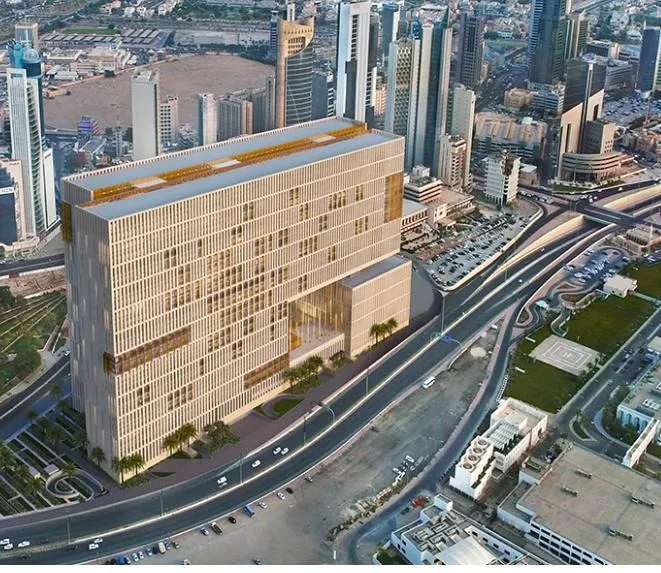
- Kuwait City has towers and government buildings with large central plants. Priorities are chiller optimisation, energy reporting and integration. See our page on Kuwait City.
- Hawalli and Salmiya have mixed-use towers, malls and hotels where tenant sub-metering and comfort complaints dominate. See Hawalli and Salmiya.
- Farwaniya has commercial buildings and clinics where compact systems and clear alarms matter. See Farwaniya.
- Al Ahmadi and Fahaheel include industrial and institutional sites where reliability and simple maintenance are more important than complexity. See Al Ahmadi and Fahaheel.
You can also look at the types of buildings we work on in our projects and industries pages. Large public buildings such as the Kuwait Stock Exchange show the level of coordination expected on landmark work.
Retrofit: improving a building you already have
Most buildings in Kuwait are already built, so retrofit is a major opportunity. A good retrofit begins with a survey, and then focuses on quick wins.
- Reconnect or repair existing controls. Many buildings have a BMS that has quietly stopped working. Fixing sensors, actuators and communication can recover control at low cost.
- Add metering. Energy meters on main plant and floors show where to focus.
- Fix schedules and set points. This is free and often produces immediate savings.
- Add variable speed drives to fans and pumps that run at constant speed.
- Expand gradually. Phase additional systems over several budgets.
How to write a BMS specification that works
If you are a consultant or owner preparing a specification, include these elements:
- Scope by system, with a points list template.
- Protocols and integration requirements, naming open standards.
- Sequences of operation or a requirement for the contractor to submit them for approval.
- Graphics requirements. Clear, consistent, with trends and alarm summaries.
- Alarm management. Priorities, notification paths, acknowledgement.
- Cyber security requirements. Network separation, user roles, patching.
- Testing and acceptance. Point-to-point tests, functional tests, witness requirements.
- Training and documentation. Number of sessions, manuals, as-built drawings, program backups.
- Warranty and support. Duration and response times.
Looking after the system after handover
A BMS needs light but regular care.
- Back up programs and databases every time a change is made.
- Review user accounts at least twice a year and remove people who have left.
- Calibrate or check critical sensors annually.
- Review alarms monthly. Repeat alarms point to a real problem or a badly set limit.
- Review energy trends monthly and compare to the same month last year.
- Keep spares for sensors, relays and power supplies that fail most often.
The cost question
Owners often ask for a price per point. It is a useful rough comparison, but it hides the important differences: the quality of the controllers, the amount of programming and graphics, the commissioning effort and the training. Compare proposals by scope, not just by price. A system that is installed cheaply and never properly commissioned will cost far more in energy and complaints than it saves at purchase.
Questions to put to a BMS bidder
A short interview with each bidder reveals a great deal. Ask who will write the control programs and where they are based, because the person who programs the system is as important as the brand. Ask for an example of a sequence of operation they have written for a similar plant, and for the name of a client who can describe how the system performs two years after handover. Ask how they handle alarm management, whether the owner will receive full administrator rights and program backups, and what happens if the original installer is no longer available. Answers that are specific and confident are a good sign. Vague promises about smart technology are not.
Ready to plan your BMS
Send us your plant schedule, drawings or a description of the problem you want to solve. Our engineers will review the information and suggest a sensible scope: what to control, what to monitor and what to leave alone. Use our quote form or call +965-51133630. You can also explore our full range of services, including power distribution and lighting control, which work hand in hand with a BMS.
A BMS is not a gadget. It is a management tool, and like any tool it gives its best results when the people using it understand it, trust it and look at it regularly.
Frequently asked questions
What is the difference between a BMS and a BAS?
The terms are used almost interchangeably. BMS often implies broader monitoring that includes energy, security interfaces and reporting, while BAS or building automation system focuses on control of mechanical and electrical plant.
Is a BMS worth it for a small building?
It depends on the plant. A building with a central chiller plant, many air handling units or high cooling loads usually benefits. A small villa or shop with split units may only need simple thermostats or home automation.
Which protocol should a BMS use?
Open protocols such as BACnet and Modbus are the safest choice because they let different manufacturers' equipment work together and give the owner more freedom later.
How much energy can a BMS save in Kuwait?
Savings depend on the building and on how well the system is commissioned and used. Air conditioning is the largest electricity user in most Kuwait buildings, so correct scheduling, set points and fault detection are where savings come from.
Who maintains a BMS after handover?
Either the owner's facility team trained by the installer, or the installer under a maintenance contract. Either way, backups, user accounts and alarm responses should be reviewed regularly.