

Imagine a school of twelve hundred students on a hot afternoon in Al Jahra. A fire alarm sounds. A bell tells everyone something is wrong, but it does not say what to do. Does a teacher gather her class in the yard or in the corridor? Is it a drill? Is the fire on this floor or another? A voice evacuation system answers those questions in clear speech, in the right languages, in the right zones, within seconds.
This guide explains how public address (PA) and voice alarm systems work, what to consider in design, how to avoid common faults and how to maintain them. It is intended for owners, consultants and facility managers in Kuwait. See our public address systems service page for what we deliver.
PA, voice alarm and PAVA: understanding the terms
- Public address (PA) carries announcements, bells and background music to speakers across the building.
- Voice alarm (VA) is a life-safety system that plays evacuation messages automatically on fire alarm. It is monitored for faults and has battery backup.
- PAVA is the combined system that offers both functions.
An excellent explanation of the difference is available from the AVIXA industry association, and the general idea is covered on Wikipedia's public address system page. For emergency sound systems, international standards include the ISO 7240-19 series, available through the ISO.
The main components
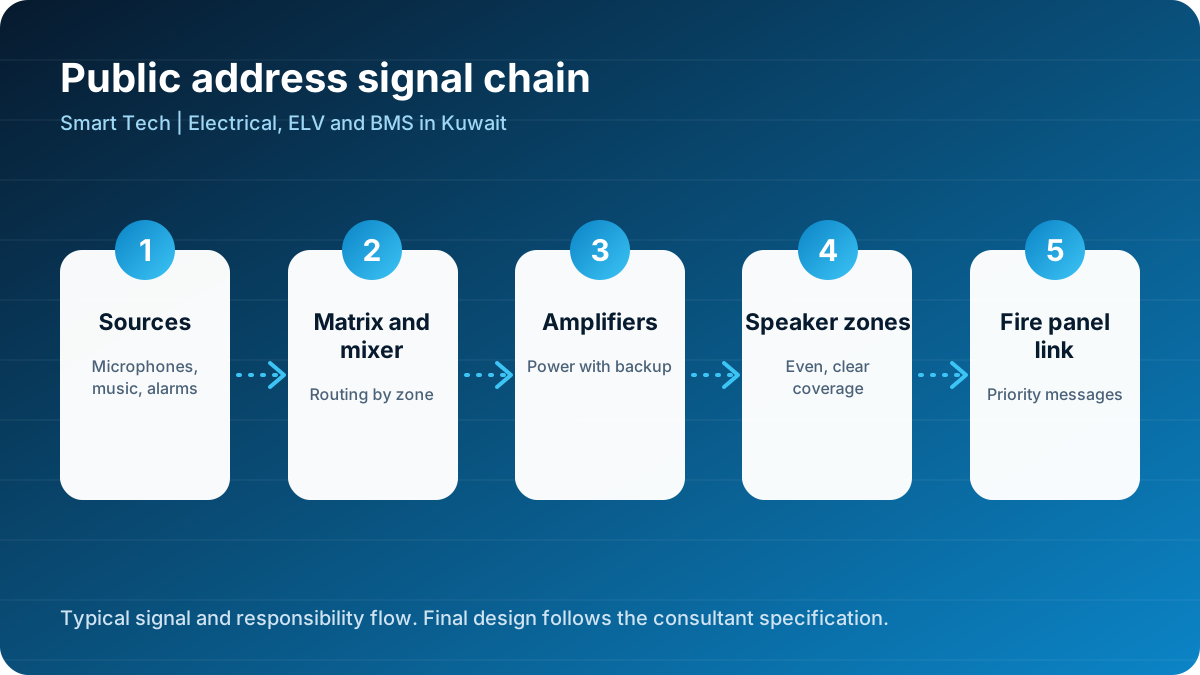
Sources. Microphones, paging stations, music players, telephone interfaces, pre-recorded message stores and the fire alarm interface.
Matrix or controller. The brain of the system routes sources to zones, applies priorities and plays messages.
Amplifiers. Power the speaker lines. In life-safety systems there is usually a standby amplifier that takes over automatically if one fails.
Speakers. Ceiling speakers for offices and corridors, horn speakers for outdoors and plant rooms, wall speakers and column speakers for halls and mosques, and sound projectors for large reverberant spaces.
Cables. Speaker lines use fire-resistant cable for life-safety circuits, and they are monitored for open or short circuits.
Power supply and batteries. The system must keep working for the required standby period if mains power is lost.
Why speech clarity beats volume
The real test of an emergency sound system is not how loud it is but whether people can understand the words. In a hard, echoing space such as a corridor, atrium, mall or sports hall, sound reflects and blurs speech. Increasing volume can make the problem worse.
Good design improves clarity by:
- Using more speakers at lower power. Spread evenly, they keep sound close to listeners.
- Choosing the right speaker type. Directional speakers or sound projectors in reverberant spaces.
- Setting the right levels above background noise. Emergency sound should be comfortably louder than the surroundings.
- Controlling reflections. Acoustic treatment, even simple wall panels, helps in noisy halls.
- Measuring intelligibility. Systems can be tested using speech transmission index measurements.

Zones: the logic behind who hears what
A zone is a group of speakers that receive the same signal. Good zoning reflects the building's evacuation strategy.
- A school might have zones for each classroom wing, the sports hall, the yard and the administration area.
- A mall has zones for each level, each store line, the food court, car parks and back-of-house areas.
- An office tower has zones for each floor plus staircases, lobbies and car parks.
- An industrial site has zones for production halls, offices, yards and perimeter.
Phased evacuation, where only the fire floor and the floors above and below are told to leave first, depends on zoning. Agree the logic with the consultant and the fire authority.
Interface with the fire alarm
The fire alarm panel and the voice alarm system must communicate reliably. A dedicated interface lets the fire panel trigger the correct message in the correct zone, and lets the voice system report faults back. Our article on fire alarm systems in Kuwait explains the fire side of this relationship. The interface should be monitored, and its behaviour should be written in the cause and effect matrix and tested at commissioning.
Priorities matter. A typical order is:
- Fire evacuation messages.
- Emergency announcements from the fire control room.
- General paging and announcements.
- Background music.
Messages in Arabic and English
Kuwait is a bilingual environment, and messages should reflect that. Record messages clearly, with a calm tone and simple words, in both languages. Keep them short. For public buildings, add other languages if the audience needs them. Test the messages in a real space, with people who do not know the content, and adjust if they are unclear.
Typical systems for different buildings
Schools and campuses
Use bell scheduling, announcements to classrooms and yards, and emergency messages. Design weather-resistant outdoor speakers and plan for large numbers of people in assembly areas. Al Jahra has many schools and growing neighbourhoods. See Al Jahra.
Malls and hypermarkets
Background music, promotions and emergency voice alarm, with strong control of noise levels. See our Aventura Mall J3 project for the kind of environment involved.
Offices and towers
Paging, background music in lobbies and voice alarm on all floors. Kuwait City has many buildings with this requirement.
Industrial sites
Rugged horn speakers, high noise levels and multiple zones. Al Ahmadi and Fahaheel include industrial and institutional sites. See Al Ahmadi and Fahaheel.
Mosques and community centres
Quality sound for speech and recitation, carefully balanced to avoid disturbing neighbours.
Hotels, clubs and stadiums
Mixed music and announcements with separate controls for events. See our industries page for the sectors we serve.
Design checklist
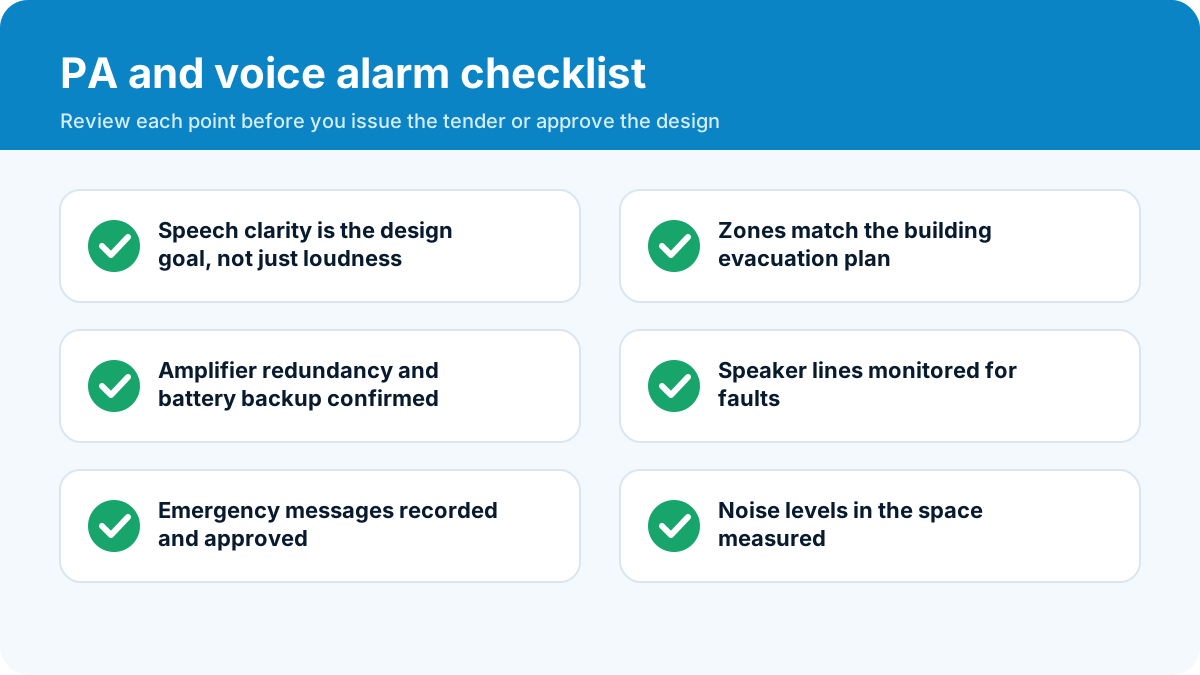
When you review a PA or voice alarm design, ask:
- Is there a zone schedule that matches the evacuation plan?
- Are speaker types and quantities suited to the space?
- Is amplifier redundancy provided for life-safety zones?
- Is cable fire-resistant and monitored?
- Is battery backup sized for the required time?
- Are messages approved and recorded in the right languages?
- Is intelligibility measured as part of commissioning?
- Who controls the system day to day and who responds to fault alerts?
Installation practice
- Pull cable before ceilings close and protect it from damage.
- Use correct cable for life-safety circuits, with proper supports.
- Mount speakers securely, aligned and, where required, with fire-rated enclosures.
- Label every line and zone to match the drawings.
- Terminate carefully with correct connectors, and test for impedance and insulation.
- Rack equipment neatly with proper ventilation and cooling. A hot amplifier rack in Kuwait's climate needs dedicated cooling.
Commissioning and testing
At commissioning:
- Test every speaker line for continuity and impedance.
- Set levels zone by zone with a calibrated sound meter.
- Test priority logic: paging overridden by emergency message.
- Simulate fire alarm triggers and check message playback.
- Test fault reporting by disconnecting a speaker line.
- Check battery backup and amplifier changeover.
- Measure intelligibility in critical spaces.
- Record results and obtain approval.
Our wider approach to documentation is described in testing, commissioning and maintenance.
Maintenance
- Weekly: test the system with a short announcement.
- Monthly: check fault indicators, microphones and message playback.
- Quarterly: test amplifier changeover, battery condition and zone logic.
- Annually: full test of every zone, speaker inspection, sound level checks and review of messages.
Keep a logbook of tests and faults. Replace batteries according to the manufacturer's life and the results of load tests.
Designing sound for a real space: three short case notes
Rules are useful, but spaces teach. These three short examples show how the same system changes with the room.
A school corridor. Long, narrow, hard-surfaced and noisy at break time. Ceiling speakers on low power, spaced evenly and at close centres, give better clarity than a few strong horn speakers at the ends. Zoning by wing lets staff call a single class without disturbing the whole school.
A mall atrium. High ceilings, glass and stone create strong echo. Directional column speakers, placed to aim sound at the audience and away from the walls, keep speech understandable. Background music is kept low, and the system lowers it automatically when announcements begin.
A workshop or factory. High noise, and workers may wear ear protection. Horn speakers with strong output, supported by flashing beacons so that the warning is both heard and seen. Levels are measured on site because noise changes with machinery.
In every case, the final step is the same: stand in the space, play a message and listen. If a person standing at the back cannot repeat the words, the design needs adjustment, however good it looked on paper.
Writing evacuation messages that work
Evacuation messages should be short, calm and specific. A good message includes the situation, the action and the route, for example: Attention please. An emergency has been reported in this building. Please leave by the nearest exit and go to the assembly point. Do not use the lifts. Repeat the message in Arabic and English, leave a short pause between repetitions and avoid technical terms. Voices matter too: a steady, clear voice with a moderate pace works better than a rushed or dramatic one. Review messages with the fire safety officer, and update them if the building layout or procedures change.
Budgeting and phasing a PA project
A PA or voice alarm system can be built in phases when budgets are tight, provided the design allows for it from the start. The cable routes, equipment rack, amplifier capacity and zones should be planned for the final system. Early phases can install the essential zones, such as classrooms and corridors in a school, with later phases adding outdoor areas or halls. Choose a controller that can grow, and leave spare space in the rack. Where voice alarm is required by regulation or the consultant, it cannot be postponed, but background music and general paging often can.
When you compare quotations, check the number and type of speakers, amplifier power and redundancy, the type of cable, the controller and message storage, the interface with the fire alarm and the cost of commissioning, including measured intelligibility. A quotation that lists only a number of speakers and a lump sum is not a design.
Training the people who use the system
A PA system is only useful if people know how to use it. Train receptionists, security staff and fire wardens to use the microphone and the paging station, to select zones and to make an emergency announcement. Print a one-page card next to the paging station that shows the steps in Arabic and English. Practise during fire drills, and review the recordings afterwards. Good practice includes speaking slowly, holding the microphone at the right distance and repeating the message. A well-trained operator can calm a building. An untrained one may add confusion.
Common mistakes
- Choosing by volume. Clarity matters.
- Not planning zones. Evacuation messages reach the wrong areas.
- Poor integration with the fire alarm. Messages do not trigger or arrive late.
- Ignoring noise. Plant rooms, kitchens and halls need extra care.
- No maintenance. Faults are discovered during an emergency.
- Using non-fire-rated cable for life-safety lines.
- Poor messages. Long, formal wording is hard to follow in a crisis.
Plan your PA or voice alarm system
Send us your floor plans and the type of building, and we will propose zones, speaker layout, amplifier sizing and a clear quotation with testing and training. Use the quote form or call +965-51133630. You can also read about our wider low current systems and the full list of services.
A PA system is invisible on a normal day. On a bad day it is the voice that tells people where to go, and it must be clear.
Frequently asked questions
What is the difference between a PA system and a voice alarm system?
A public address system broadcasts announcements and music. A voice alarm system is a life-safety system that also plays pre-recorded evacuation messages automatically from the fire alarm, with monitoring of its own faults and battery backup. Many buildings use a combined system.
Why is speech intelligibility important?
People must understand the words in an emergency. A loud but unclear message can cause confusion. Clarity depends on speaker placement, room acoustics and background noise, not just volume.
How many speakers does a building need?
It depends on ceiling height, room acoustics and noise levels. Many small low-power speakers evenly spread give clearer sound than a few loud ones.
Can the PA system play background music?
Yes. In a combined system, music and announcements share speakers, and the system overrides them automatically in an emergency.
Can announcements be made in Arabic and English?
Yes. Messages can be recorded in both languages and played in sequence, and different messages can be sent to different zones.