
A good smart home is not the one with the most gadgets. It is the one where the family walks in, presses one button and the house responds: lights at the right level, air conditioning ready, curtains moving, gate closed and doors secured. A bad smart home is the opposite: five different apps, switches that no longer work and a visitor who cannot turn on a lamp.
Villas in Kuwait are ideal candidates for automation. Cooling costs are high, houses are large, many families travel in summer and security matters. This guide explains how to plan home automation properly, what to include and what to avoid, so that the system is still pleasant to live with in ten years. Our home automation service page shows what we deliver.
What home automation actually means
Home automation connects the electrical systems of a house so they can be controlled together. The most common items are:
- Lighting, with dimming and scenes such as Welcome, Dinner and Good night.
- Air conditioning, scheduled and controlled by room, with set points and absence modes.
- Curtains and blinds, which can open with the morning light or close in the afternoon sun.
- Audio and video, including multi-room music and cinema scenes.
- Security, such as CCTV, door entry, gate and alarm status. See our guides to CCTV and access control.
- Energy and water monitoring, so the family can see what is used.
- Garden and pool controls, including irrigation timers and pool pumps.
A general introduction is available on Wikipedia's home automation page.
Wired or wireless: choose with care
Wired bus systems
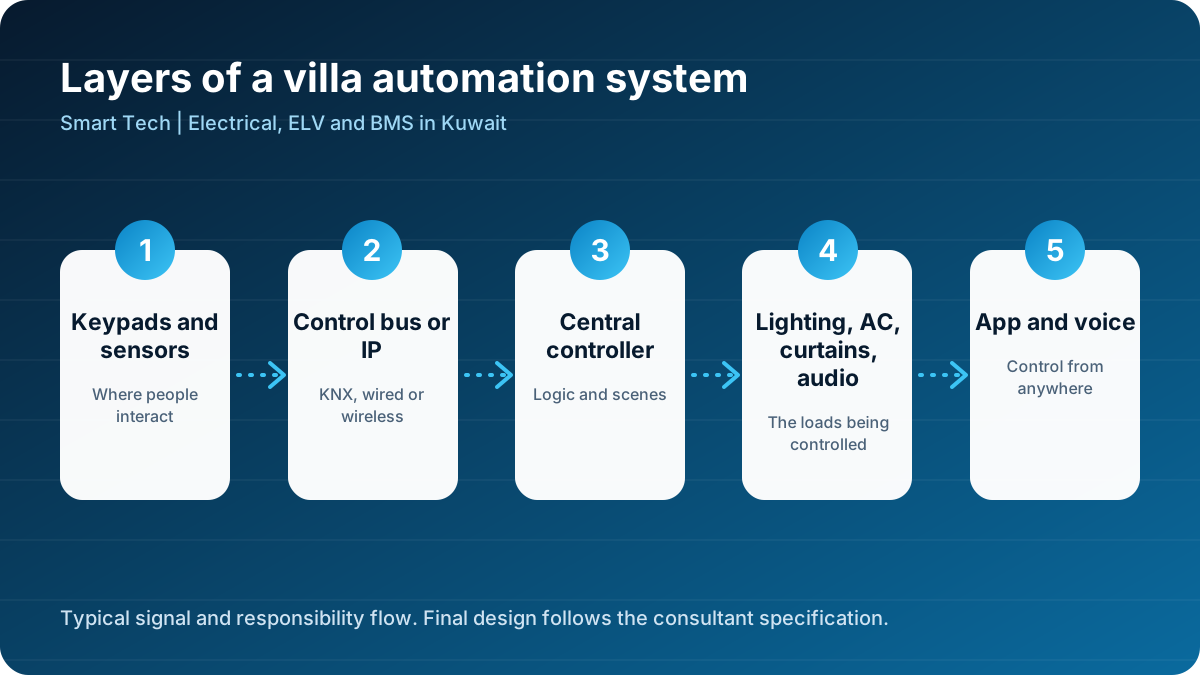
Wired systems use a dedicated cable that connects keypads, sensors and actuators. The best known open standard is KNX, supported by hundreds of manufacturers, described on Wikipedia's KNX page and on the official KNX Association site. Because the standard is open, devices from different makers work together and the owner is not trapped by one supplier.
Strengths: very reliable, keeps working without internet, long life, easy to expand.
Limits: needs planning before construction, higher upfront cost.
Wireless systems
Wireless systems use radio protocols to connect devices. They are quicker to install in an existing house and cost less at the start.
Strengths: retrofit-friendly, low disruption.
Limits: depend on radio quality, batteries need changing, thick concrete walls reduce range and some products are tied to one brand's app.
A mixed approach
Many villas use a wired backbone for lighting and air conditioning and wireless devices for add-ons. What matters is that the essentials work locally, without a cloud service.
Plan the villa room by room
The best way to plan is to walk through a normal day.
Morning. Bedroom lights come on at a low level, curtains open gradually and the air conditioning in the family room prepares for breakfast.
Departure. One button at the door switches off lights, sets air conditioning to economy, closes curtains against the sun and arms the alarm.
Evening. Arriving home, the driveway lights come on and the gate opens by app, remote or number plate recognition. The Welcome scene lights the entrance, hall and kitchen.
Entertaining. The Dinner scene dims the dining lights, plays music in the majlis and turns up the air conditioning for guests.
Night. A single button turns off the house, checks that doors are locked and lowers the temperature in bedrooms.
If you can describe these moments, an automation designer can turn them into a specification. If you cannot, the system will be designed around products and not around people.
Lighting: the foundation of a smart villa
Lighting is the system the family notices most. Plan these points.
- Use quality dimmable LED fixtures and drivers that match the control protocol. Mismatched drivers cause flicker and noise. Read more in our article on lighting control and energy savings.
- Plan scenes, not switches. One keypad button can control ten fixtures.
- Include layers. Ambient, task and accent lighting create atmosphere.
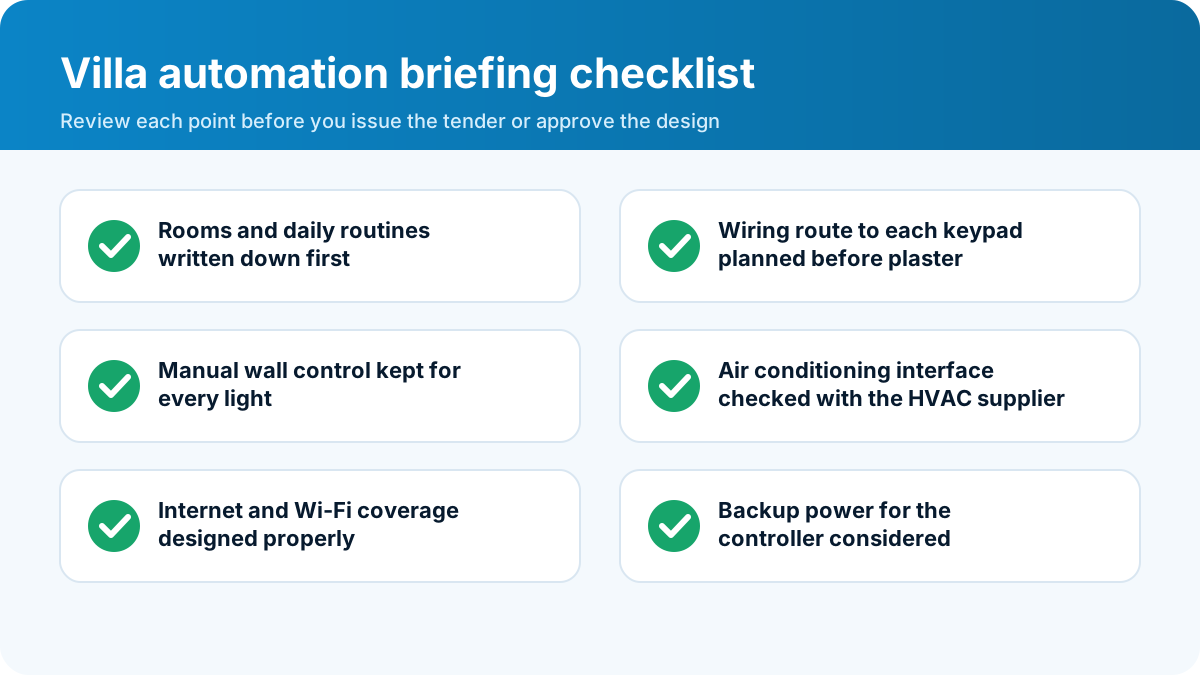
- Keep manual control. Every room should have a clear, traditional-feeling wall keypad so guests can use the lights without an app.
- Provide for emergencies. A single button at the bedside that turns on all the lights is a very practical feature.
Air conditioning: where money is saved
Air conditioning is the largest part of a villa's electricity bill. Smart control reduces waste without reducing comfort.
- Schedule by room. Bedrooms cool at night and not during the day. The majlis cools before guests arrive.
- Use occupancy and door contacts. If a window or a patio door is open, the system can pause cooling.
- Allow remote control. If the family returns early, they can start cooling from the car.
- Limit extremes. A maximum and minimum temperature prevents accidental overcooling.
- Monitor. Seeing which unit runs most helps find faults.
Compatibility matters. Check that the chosen interface works with the specific air conditioning units. Some units accept a simple dry contact, others use proprietary protocols that need a gateway.
Curtains and blinds
Motorised curtains protect furniture from sun, reduce heat and add comfort. Choose motors designed for the weight and length of your curtains. In Kuwait, sun-facing windows are the best candidates for automation. Link curtains to a sun schedule so that they close at the hottest part of the afternoon in summer.
Audio, video and entertainment
Multi-room audio is popular in majlis, living rooms and gardens. Keep the design simple: a central source, quality amplifiers and in-ceiling or in-wall speakers. Outdoor speakers need weather-rated models. Avoid layers of remote controls by using one app or keypad for all functions.
Security and safety at home
A villa is a private place and security should be quiet and effective.
- Video door entry with a screen in the hall and on the phone.
- CCTV covering gates, walls and entrances, with clear signs.
- Alarm integration, so that arming the house also sets lights and closes curtains.
- Leak and smoke alerts, sending a message if water or smoke is detected. Life-safety alarms should still operate independently, as described in our article on fire alarm systems.
- Gate and garage control, linked with lighting and CCTV.
Networking: the invisible foundation
Every smart villa depends on a good network. Plan Wi-Fi coverage with enough access points, cabled back to a central cabinet. Use quality structured cabling for TV, data and cameras, as explained in our article on structured cabling. Provide a small UPS for the network equipment and controller so the system stays alive during short outages.
Planning timeline for a new villa
- Concept stage. Meet the designer early. Agree the list of systems and decide which are essential.
- Design stage. Produce a schedule of rooms, keypad locations, scenes and interfaces.
- First fix. Install cables, back boxes and conduit before plaster. Mistakes at this stage are expensive to fix.
- Second fix. Install devices, keypads, panels and fixtures.
- Programming and commissioning. Set up scenes, schedules and the app. Test every room.
- Handover and training. Explain the system to the family and domestic staff, provide a simple guide and keep a backup of the configuration.
What it costs and how to control the budget
Budgets depend on the number of rooms and on how many systems are controlled. To manage cost sensibly:
- Automate lighting and air conditioning first. They deliver the most daily benefit.
- Add curtains in key rooms rather than everywhere.
- Prepare cabling for future features even if you do not buy them now.
- Choose open standards so that future expansion does not depend on one supplier.
- Ask for a room-by-room price so you can add or remove items.
Home automation in Kuwait's residential areas
Villa and house construction continues across the country, and each area has its own pattern.
- Al Jahra has expanding residential areas with large plots where gate control, garden lighting and cooling control are popular. See Al Jahra.
- Mubarak Al-Kabeer has well planned residential neighbourhoods where families value comfort, safety and low running cost. See Mubarak Al-Kabeer.
- Hawalli and Salmiya include many apartments where wireless and retrofit solutions are common. See Hawalli and Salmiya.
- Farwaniya and Al Ahmadi have a mix of villas and low-rise buildings. See Farwaniya and Al Ahmadi and Fahaheel.
A sample room-by-room scope for a four-bedroom villa
Seeing a real scope makes planning easier. The following example is a typical starting point for a four-bedroom villa with a majlis. It is an illustration, not a quotation, and every house is different.
Entrance and hall. A video door station at the gate and the door, a welcome scene, a wall keypad with four buttons, dimmable downlights and a pendant, and a door contact for the alarm.
Majlis and living room. Dimmable lighting in three layers, two curtains on motors, a thermostat linked to the air conditioning, multi-room audio zone and a scene keypad. The majlis scene sets cooling, lighting and music for guests with a single press.
Kitchen and dining. Task lighting over worktops, a dimmable dining pendant, leak detection near the sink and a simple keypad. Extractor fans are best left on their own switches, but they can be monitored.
Bedrooms. Bedside controls for the main light, a night scene that lights a low path to the bathroom, motorised curtains in the master bedroom, and an air conditioning controller with a night schedule. Children's rooms benefit from simple switches and a parent override.
Outdoor areas. Garden lighting on schedules, a gate controller, a camera at the driveway and pool pump timers.
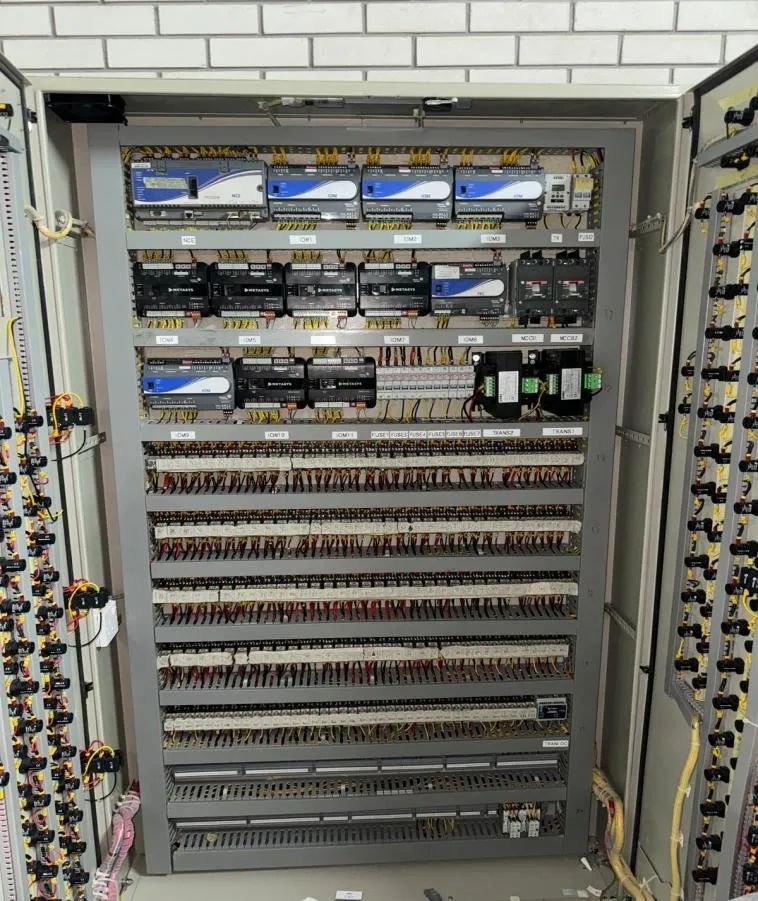
Technical room. A tidy cabinet with the controller, network equipment, a UPS and labelled cables. This is the heart of the system, and it should be reachable and well ventilated.
When you list a scope this way, you can see exactly where the money goes and what can be postponed. A good integrator will also point out where simple wiring is better than clever technology.
Living with the system: habits that keep it smooth
A smart villa stays smart when the family and staff know how to use it. Hold one short training session for everyone, including domestic staff. Print a one-page guide that shows each keypad button. Agree who is allowed to change schedules, because accidental changes are the most common cause of "the system stopped working." Finally, keep one spare keypad button labelled All off near the main door. It is the feature that visitors and relatives use most, and it costs almost nothing.
Choosing an integrator you can trust
The designer matters as much as the products. Ask to see a completed villa that is at least two years old, and ask the owner how the system has behaved. Check that the integrator provides a written scope, a room schedule and a clear price. Confirm who will program the system and whether you will receive a copy of the programming and passwords. Ask about service: who answers a call on a weekend and how quickly. A reliable integrator will explain what the system cannot do as clearly as what it can, and will be comfortable keeping things simple.
Mistakes to avoid
- Choosing products before needs. Write the daily scenarios first.
- Forgetting manual control. Guests and children must be able to switch on a light.
- Relying on the cloud. Local control must keep the essentials working.
- Mixing too many brands without integration. Fewer systems that work well are better than many that do not.
- No documentation. Keep a record of programming and passwords.
- Ignoring maintenance. Batteries, firmware and backup need attention.
Maintenance and support
A simple yearly check keeps the system healthy: test scenes, check batteries in wireless devices, update firmware where recommended, review user accounts and back up the configuration. Ask your installer for a support agreement that defines response times and remote assistance.
Start your villa project the right way
Send us your plans, or tell us how your family lives, and we will propose a simple, well-organised design with a clear price. Use our quote form or call +965-51133630. You can also read about related services such as lighting control and security systems, or see all our services.
A smart villa should feel simple. When it is designed carefully, the technology fades into the background and what remains is comfort, safety and lower bills.
Frequently asked questions
How much does villa automation cost in Kuwait?
Cost depends on the number of rooms, the systems included and the quality of devices. A basic package for lighting and air conditioning control costs far less than a full system with curtains, audio, security and a central panel. A site visit and a written scope are the only reliable way to price it.
Should I choose a wired or wireless system?
Wired systems such as KNX are the most dependable for new villas because they keep working without internet and last for decades. Wireless systems are easier to add to an existing home but depend on signal quality and battery life.
Will my villa still work if the internet fails?
A properly designed system keeps lights, air conditioning and scenes working locally without internet. Only remote access and cloud voice assistants depend on a connection.
Can I automate an existing villa without breaking walls?
Yes, with wireless or relay-based solutions in the existing switch boxes. Results are good for lighting and curtains, but a new build allows a cleaner and more complete design.
Which voice assistants can I use?
Most modern systems can be linked to common voice assistants. Voice should be an extra convenience and not the only way to control essential lights or air conditioning.